Myths & facts
MYTHSB 1090 freezes rebuilding and prolongs displacement.
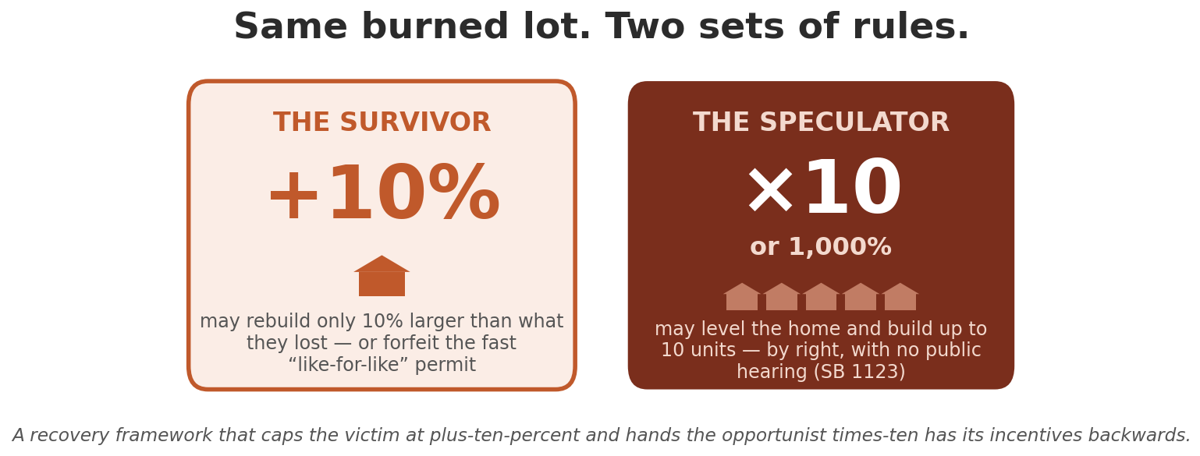
FACTIt pauses only by-right subdivision of a burned lot into as many as ten units. Every survivor keeps the fast like-for-like rebuild, ADUs, and disaster permitting — the pathways thousands are already using to come home. What it pauses is speculative lot-splitting, which does not slow the recovery.
MYTHThese are mostly local Altadenans rebuilding and improving the property they already own.
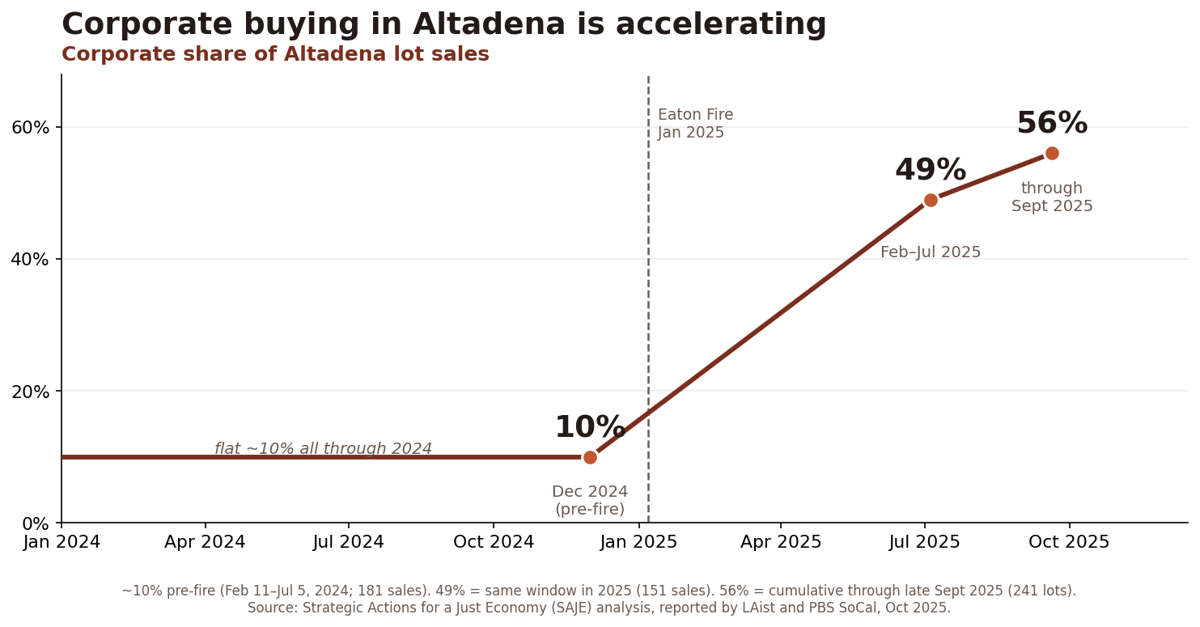
FACTIt's coming from outside, not from the families who lost their homes. 100% of the SB 1123 subdivisions we've identified are outside buyers who purchased after the fire — investors, LLCs, and one out-of-area trust — not one a returning Altadena resident. Even in the SB 9 rebuild lane, more than 1 in 3 (19 of 55) are outside buyers, not the original owner. And none of it — 0 of 70 — is someone adding a unit to a house still standing; every project is new construction on a lot the fire destroyed.
MYTHSB 1090 singles out Altadena and denies its homeowners rights other Californians have.
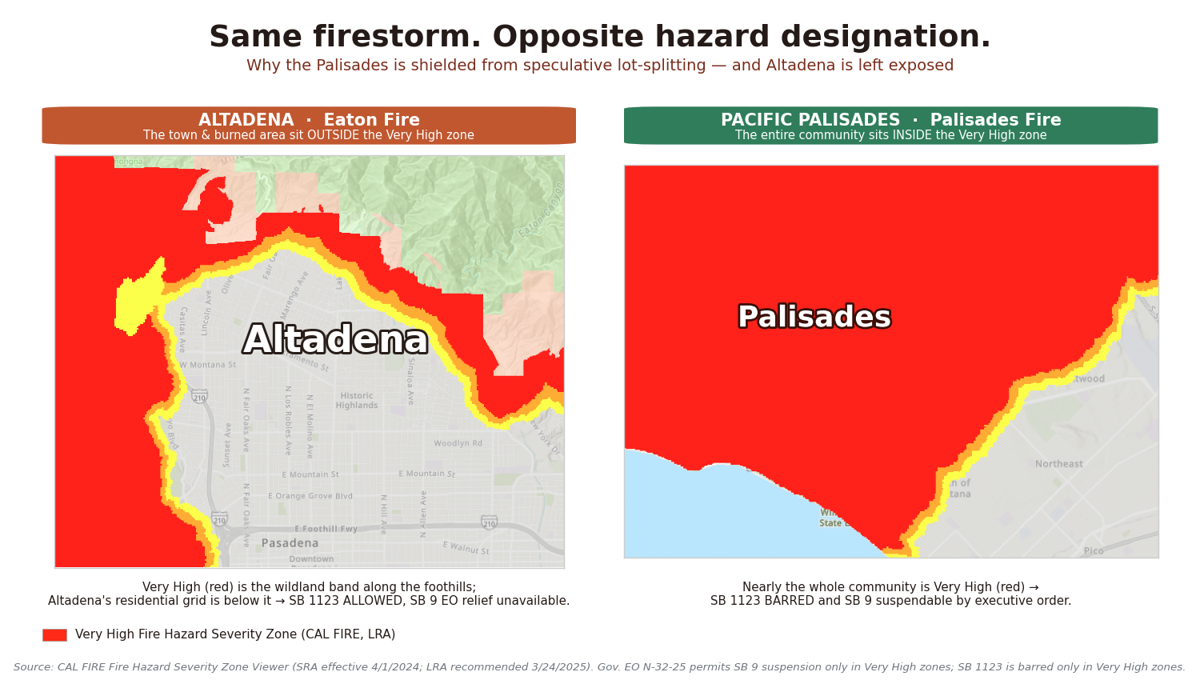
FACTThe State already gave the Pacific Palisades this exact protection by executive order (N-32-25) after the same firestorm. SB 1090 asks only for the same. It is look-forward, time-limited disaster relief, bounded to ZIP Codes 91001 and 91003 for applications submitted January 2027 through January 2030 — not a permanent or unique burden.
MYTHDevelopers pay survivors a premium, and single-family rebuilding "doesn't pencil."
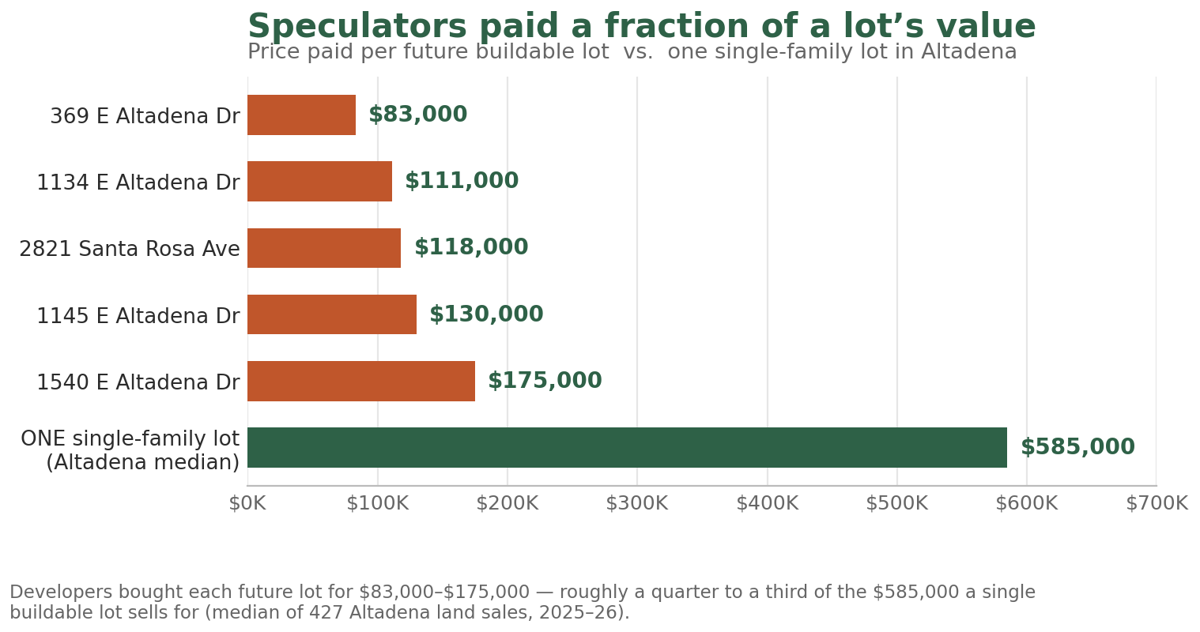
FACTRecorded sales show the opposite. Large burned lots have sold arm's-length at about $58–63 per square foot (e.g., 1625 Braeburn Drive, $2,088,000), versus the roughly $20 per square foot the developers' own "single-family value" implies — about a third of the market. They acquire at or below market; the multi-unit yield is value the statute hands the developer, not a premium paid to survivors.
MYTHBlocking subdivision means a wealthy-only Altadena.
FACTA false choice. The County's own ADU ordinance already allows a primary home plus up to four dwelling units on a single lot — with no subdivision (and SB 1123 lots are actually barred from ADUs). What subdivision delivers is market-rate, townhome-style units capped by statute at 1,750 sq ft average (Gov. Code §66499.41) — built for the upwardly mobile, not for the multi-generational families who gave Altadena its character. Income-diverse recovery comes through land trusts, ADUs, and corridor housing.
MYTHEach subdivision includes an affordable home, so it serves affordability.
FACTNothing in the law requires it. SB 9 and SB 1123 carry no affordability requirement and no obligation to deed-restrict a single unit on these lots. SB 9 mandates no affordable unit at all; SB 1123's only affordability trigger reaches parcels a jurisdiction's housing element designates for low-income housing — which Altadena's burned single-family lots are not. So any "affordable" home a developer touts is voluntary marketing, not a legal obligation. And even that one optional unit would leave nine at market rate, set at 120% of area median income — roughly $128,000 for a family of four, moderate not low income — with none reserved for fire survivors. A single covenanted unit is not an affordability program.
MYTHBuilders are the only way burned lots come back.
FACTSurvivors and owner-builders are already buying and rebuilding through ordinary permits, not subdivision. The obstacle is competing for permit processing times, not a shortage of subdivision rights: by-right subdivision gives a developer priority over a homeowner that is still awaiting insurance or Edison proceeds. Pausing it returns land to a price families can pay.
MYTHA County brochure promoted SB 1123, so buyers acquired vested rights.
FACTA brochure is not a vested right. Under California law (Avco Community Developers v. South Coast Regional Comm., 1976), vesting requires an issued permit plus substantial, good-faith construction; SB 1090 reaches only projects with no permit. The brochure was aimed at survivors dividing and selling part of their own land — not at outside investors buying whole lots to subdivide. Where government erred, it should be free to correct course going forward.
MYTHAdding homes on these lots is safe — projects still pass fire and water checks.
FACTWill-Serve letters and fire sign-off are unit-by-unit checks, not a cumulative evacuation or system-capacity study. Altadena's foothill blocks sit on narrow, often single-access streets that just failed in a deadly evacuation — many on septic, without sidewalks, on a grid still being rebuilt. The County's own Planning memo (Dept. of Regional Planning, May 18, 2026) says the state mandate lands density where "infrastructure or site requirements do not meaningfully support" it, and flags SB 1123 as posing "similar challenges."